 Mummy finance
: Network, Collateral, and Trade Constraints
Mummy finance combines self-custodial token swaps with leveraged perpetual trading, while network, product version, collateral, and liquidity determine which action can execute. A wallet connection alone does not establish compatibility: the selected chain, supported asset representation, available pool capacity, fee state, and liquidation terms must match the intended transaction.
updated
On this page
Compatibility, collateral state, live fees, and liquidation distance determine whether a Mummy finance trade can execute and remain open.
Network and product mode
Network selection determines which contracts, balances, markets, and fee rules the wallet can reach. The active chain must match the chosen Mummy finance deployment before an approval, swap, deposit, or position request can succeed. A balance held elsewhere does not become available merely because the wallet address stays the same.
V1 and V2 are separate trading systems. V1 supports spot swaps and perpetual positions through a multi-asset liquidity pool. V2 uses a stablecoin-backed pool and concentrates on perpetual markets, while the broader interface also provides an aggregator-based swap route. A feature visible in one mode should not be assumed to exist in the other.
The versions also use different price feeds, collateral rules, order types, and liquidation behavior. V1 relies on Chainlink pricing, while V2 uses Pyth data. Contract state and supported markets can differ between networks, even when navigation labels appear identical.
Choose the network and product mode before evaluating a quote. Otherwise, every later balance or fee comparison may describe the wrong transaction.
The commitment boundary
The commitment boundary is the final review state before a signed request exposes funds to contract execution. A token approval only grants spending permission. It does not open a position, guarantee a fill, or confirm that the available liquidity can support the requested size.
- Confirm that the wallet uses the network associated with the selected contract.
- Match the collateral asset and its contract representation to the accepted input.
- Read the proposed direction, collateral amount, leverage, and total position size.
- Compare the displayed fees, execution price, slippage limit, and liquidation price.
- Identify whether the instruction is a market, limit, stop market, or stop limit order.
A submitted V2 market order first enters a pending state while keeper nodes validate and execute it. A transaction receipt proves that the request reached the network, not that the position opened. The open-position record confirms executed exposure, while the open-order record shows an instruction that is still waiting.
Collateral and exchange balance
Collateral governs both access to a position and the distance between the entry price and liquidation. Position size divided by collateral produces the displayed leverage before profit, loss, and accrued fees change the account state. Less collateral for the same exposure leaves less room for an adverse price move.
V1 and V2 apply different collateral models. V1 uses the asset in a long position as collateral, while short positions use supported stable assets. In V2, depositing supported stable collateral credits a USD-denominated exchange balance that funds perpetual positions. Free exchange balance remains distinct from collateral already committed to an open trade.
A familiar ticker does not prove compatibility. The same symbol can refer to different token contracts or bridged representations across networks. The deposit contract must recognize the precise asset held by the wallet. If it does not, an apparently sufficient balance cannot fund the position.
Adding collateral lowers effective leverage and can move the liquidation price farther from the market. Withdrawing collateral has the opposite effect and may fail if the remaining amount violates position requirements. Stable collateral also carries contract, liquidity, and depegging exposure while it remains in the trading system.
How do fees alter a position?
Fees reduce free collateral, realized proceeds, or the equity supporting an open position. The relevant cost is not one headline percentage. It can include position fees, funding, borrowing, artificial slippage, and network execution costs, each driven by a different input.
V2 calculates the position fee by multiplying position size by the rate configured for that asset. The protocol applies this fee when a trader opens, increases, or decreases a position. Because the calculation uses position size, leverage can make the fee materially larger than a collateral-only estimate suggests.
Funding responds to the imbalance between long and short open interest. A positive rate transfers value from longs to shorts, while a negative rate reverses that direction. The interface presents an hourly rate, although funding fees accrue every block and the funding index updates when a contract function is called.
Borrowing cost uses position size, the configured asset rate, and the time held. Network gas and any keeper execution charge remain separate. Review the complete preview because a change in size, duration, imbalance, or pool utilization can alter the eventual cost.
Oracle prices and keeper execution
Oracle prices provide the mark used to evaluate orders, profit and loss, and liquidation. V1 and V2 do not share the same oracle design. V2 reads Pyth prices, while V1 uses aggregate pricing based on Chainlink data. The chart alone does not establish the executable price.
A V2 market order first becomes a pending request. Keeper nodes monitor that state, validate the position, and execute it using the latest applicable oracle price. Price movement during this interval can separate the preview from the final entry, even when the original transaction succeeds.
V2 also applies artificial slippage according to position size and vault utilization. A trader can set a maximum accepted slippage boundary for the request. Execution stops if the adjusted price falls outside that boundary, leaving a failed or unfilled request rather than the intended position.
The final position record should show the executed size, entry price, collateral, and liquidation price. Those fields provide stronger confirmation than a wallet notification that reports only the request transaction.
Liquidation as a changing threshold
Liquidation occurs when the position no longer retains enough collateral under the applicable threshold. The calculation changes after entry because profit and loss, funding, borrowing, and position adjustments continue to affect the equity available to support the trade.
V2 compares accrued fees with a configured fraction of collateral plus profit or loss. Position size, average entry price, collateral, and accumulated costs therefore shape the liquidation price together. An adverse move and growing fees can move the threshold toward the mark price at the same time.
Adding collateral can create more distance from liquidation without changing the market direction. Reducing position size can also lower exposure. Neither action erases fees already accrued, and both require successful execution before the displayed risk state changes.
A pending collateral request offers no protection until the contract applies it. The updated collateral and liquidation price must appear in the position record.
Liquidation behavior differs by version. V2 uses whole-position liquidation, while V1 can liquidate part or all of a position under its own rules. Assess liquidation risk under the selected version’s rules rather than applying the other version’s liquidation model.
Order paths and position controls
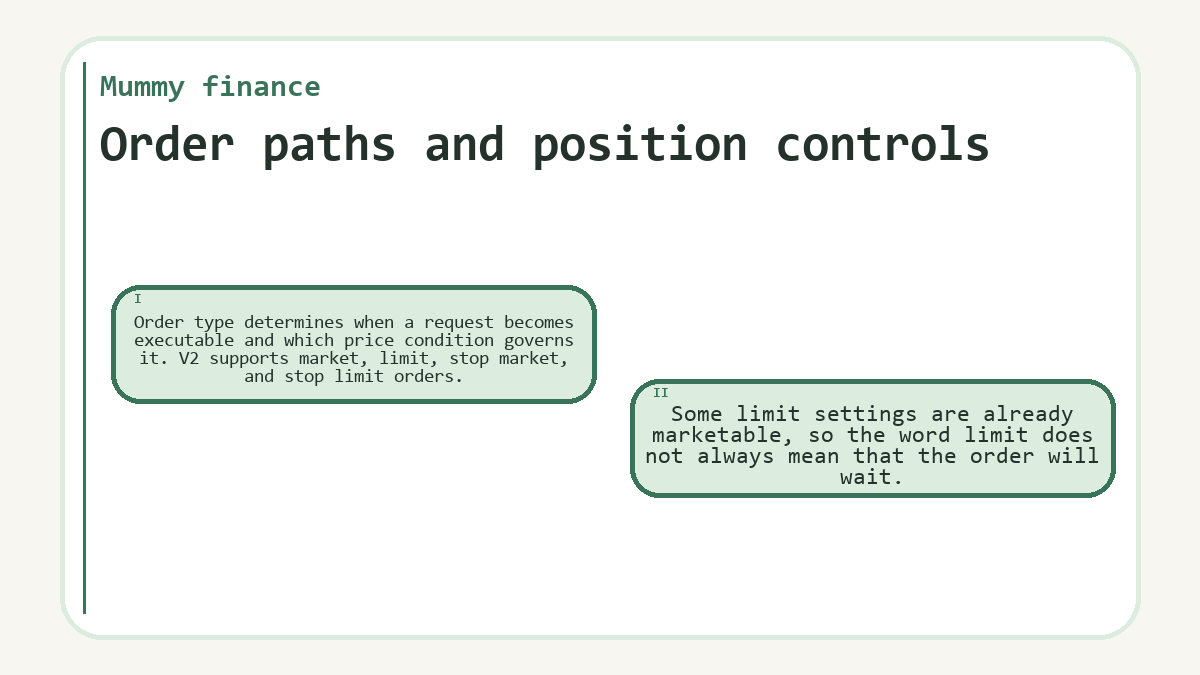
Order type determines when a request becomes executable and which price condition governs it. V2 supports market, limit, stop market, and stop limit orders. Some limit settings are already marketable, so the word limit does not always mean that the order will wait.
Take-profit and stop-loss instructions can be attached when a position opens. V2 also supports editing triggered orders and using a trailing stop. These controls create separate execution instructions; they do not reserve an exact fill price or remove the need for keeper execution.
An open position can be increased, supplied with more collateral, or closed partially or fully. Each change affects at least one of position size, leverage, available collateral, fees, or liquidation distance. A partial close realizes only the selected share while the remaining exposure stays active.
Position rows and open-order rows represent different states. After any manual close or edit, check both areas. The position record confirms exposure, while the order record shows instructions that may still wait for their trigger conditions.
A compatible request from preview to proof
This hypothetical example uses an unnamed supported network, 82 USD of its accepted stable collateral, 6x leverage, and a 492 USD position. These values illustrate the state checks only; they are not live limits or recommended settings.
A reader requests the position and receives a preview showing the proposed size, proposed entry price, fees, and liquidation price. The requested 492 USD exposure equals six times the hypothetical 82 USD collateral value before fees.
The dependency check then finds that the wallet holds accepted collateral worth a hypothetical 82 USD on a different network. The symbol looks the same, but the selected contract reports no usable collateral. The request cannot execute with that network mismatch.
Once the wallet holds the accepted asset representation on the selected network, has native gas, and has granted any required token approval, the reader funds the V2 exchange balance and confirms enough free balance for 82 USD of collateral and the displayed opening cost. The reader then submits the position request. The wallet confirms submission, while the trading interface marks the position as pending during keeper execution.
The open-position record confirms completion when it displays the 492 USD size, 82 USD collateral value, execution price, and liquidation price. If those fields never appear, the wallet receipt proves only the request, not the intended state change.
Pool capacity and protocol limits
Pool capacity can reject an otherwise valid order. In V2, open-interest limits apply by user, asset, and direction, while available exposure also depends on the stablecoin liquidity supporting its pool. V2 profit limits can force a position closed, and minimum-profit-duration rules can delay closes that exceed configured profit thresholds. These controls respond to liquidity and risk conditions, so a previously accepted size or close request does not establish a permanent limit.
Swaps, liquidity, and token roles
Swaps, perpetual positions, and liquidity provision create different on-chain exposures. A swap exchanges one token holding for another. A perpetual position tracks price movement with collateral and leverage, without transferring ownership of the referenced underlying asset to the trader.
The aggregator route can search external decentralized liquidity for a token swap. The quote and transaction preview may show the selected route, swap fees, slippage, and network gas. A successful approval still needs a later swap transaction, and the amount received confirms completion.
Liquidity providers take the other side of the trading system’s economics. MLP represents the V1 multi-asset pool, while MSLP represents V2’s stablecoin-backed liquidity. Trader losses can benefit the pool, and trader profits draw value from it. Pool holders also retain smart-contract, asset, and depegging risks.
MMY has utility and governance functions within the wider ecosystem, but holding it does not replace collateral compatibility or contract capacity. Rewards and staking belong to a different state from an open trade. The relevant checks change when a user moves from trading into liquidity provision or token staking.
Mummy finance: quick answers
Does Mummy finance require a username and password?
Mummy finance uses wallet-based access rather than a conventional username and password for its documented trading flow. The wallet address identifies the account, and signed transactions authorize on-chain actions. A connected wallet still needs the correct network, accepted collateral, sufficient native gas, and any required token approval before a trade request can move forward.
Do I need a network’s native token to submit a trade?
Yes, a wallet generally needs the active network’s native token to pay gas for approvals and transaction requests. Some flows also quote an execution fee used for keeper activity. The quoted execution fee and the wallet’s gas balance serve different purposes, so a funded collateral balance does not by itself prove that the request can be submitted.
Can one V2 exchange balance be used across different networks?
No, a balance recorded by contracts on one network does not automatically exist on another network, even when the wallet address and token symbol look identical. Moving value requires a supported transfer or bridge route and the correct asset representation. Confirm the destination balance on the selected chain before treating it as available collateral for a position.
Where does profit appear after a V2 position closes?
V2 records profit as USD in the exchange balance after a position closes. That balance can support another position or be redeemed through the available USDC flow. The closing transaction, realized profit or loss, fees, and final free collateral should agree before the proceeds are treated as settled. A pending request is not final settlement.
Is more than one V2 position allowed for the same asset?
Yes, V2’s documented model permits multiple trades for the same asset, whereas V1 limits a user to one position per asset at a time. Separate positions still face account and market constraints where applicable. Read each position’s size, entry price, fees, and liquidation level independently instead of treating the rows as one combined trade.
Does manually closing a V1 position cancel its trigger orders?
No, the V1 flow states that associated trigger orders can remain open after a manual close, so they require separate cancellation when no longer wanted. Review the open-orders panel after closing, especially before opening another position in the same market, because an old trigger may otherwise remain eligible for execution.